


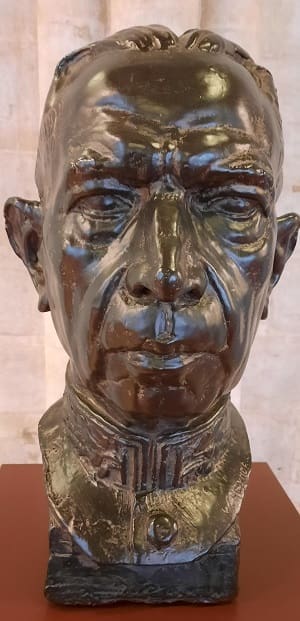
BUSTE HENDRIK HEYMAN (WERNER HEYNDRICKX)
He was the eldest of four brothers with shoemaker Pieter Frans Heyman and Philomena Janssens in the Nieuwstraat. He became a schoolmaster at Tereken and there he also met his wife, Maria Louise Van Puyvelde, with whom he had three daughters after his marriage in 1907.
He engages in the Christian labour Movement and becomes president of the ACV as from 1914. In WWI he was active at the Iron Front and remained active in the Christian labour movement there as well.
After WWI, Hendrik Heyman was elected into Parliament for Sint-Niklaas constituency, a position he held until his death, as well as the position of city councilor of Sint-Niklaas. He was also mayor of the city from 1933 to 1946. In 1944, W. Heyndrickx made this statue.
In 1927 he became a minister in several cabinets: industry, labour and social welfare. On August 4, 1930 “the Heyman law” was passed, which provided - and still provides - for a generalization of family allowances and child allowances for employees.
In addition to social security, he changed technical education and supported the introduction of Dutch as the teaching language at the State University of Ghent.
He fled to France in May 1940 and in September 1944 took up the mayor's seat again until the end of 1946. From 1945 he received the title “Minister of State".
Hendrik was an affable man, very thrifty, a staunch believer in Christianity and a supporter of the Flemish cause (“flamingant). He was a gifted writer and especially an orator and was strongly committed to the social conditions in Sint-Niklaas and later throughout Belgium.
Hendrik Heyman is known in Sint-Niklaas and in the Waasland under the nickname “De Frak Heyman”(the Heyman coat”). Actually, he inherited this name from his father, but he made every effort to keep it. When he was not walking around in ceremonial clothes, he walked the streets wearing somewhat outdated attire and especially a coat that was certainly one size too big. Hence the origin and continuation of the nickname!
Thanks to Erik Heyman for the info.
HEYNDRICKX WERNER (°1909-+1986)
Werner Heyndrickx was a sculptor of portraits and figures. His father, Jozef Heyndrickx, was a stonemason. Education at the academies of Sint-Niklaas and Antwerp and at the National Institute of Fine Arts in Antwerp (studio of E. Wijnants). Teacher of sculpture at the Municipal Academy of Fine Arts in Sint-Niklaas and the Higher Institute in Antwerp
His workshop was situated near the Tereken cemetery in Sint-Niklaas. For bronze casting he always worked with Achiel Vindevogel in Zwijnaarde. He attached major attention to the patina of a statue.
Particularly in Werner Heyndrickx's early works one can still clearly sense the influence of his teachers Arthur Dupon and especially Ernest Wijnants: in the monumentality and in the reduction of an image to a number of stylized surfaces . This rather synthesizing style is recognisable in the sculptures of the apostles he made for the church of ‘Kristus Koning’ in Sint-Niklaas. Even though heads, hands and feet have been executed with precision and detail, the vertical folds are stylised. The same approach can be seen in the sculptures ‘Contemplatie’ and ‘Familie’.
Werner Heyndrickx’s portraits exhale sharp observation. They are the result of a relentless search for an accurate resemblance and for the subject’s character.
He took part in many exhibitions in Belgium and abroad: Antwerp, Ghent, Liège, Namur, Paris, Prague and Bratislava. Prizes : the 'Godecharle Prize', the 'Van Lerius Prize', the 'Doutrolon de Try Prize' and the 'Prize of the Province of East Flanders for Sculpture'.
Kunst in de Stad displays some fifteen works by this sculptor.
-

- 40-Buste Hendrik Heyman
-

- 40-Buste Hendrik Heyman
-

- 40-Buste Hendrik Heyman
-

- 40-Buste Hendrik Heyman
Kunst in de Stad, april 24, 2010